
This is the second article in a short series on how shifting constraints are reshaping the role of business software.
AI is often blamed when it fails to deliver. Models underperform. Outputs don’t make sense. Results don’t align with reality. The conclusion many teams jump to is that the technology isn’t ready.
In practice, AI didn’t break most business systems. It exposed them.
I’ve spent years working with production data systems long before AI was part of the conversation. What AI is doing now is applying pressure to assumptions that were already fragile. Where humans could compensate for ambiguity, inconsistency, and missing context, models cannot. They force precision, which is proving to be uncomfortably revealing for some.
Why These Problems Stayed Hidden for So Long
Most business data systems evolved alongside human workflows. When a field was inconsistently populated, someone knew how to interpret it. When a report was “mostly right,” a knowledgeable analyst could correct it mentally. When pipelines broke, people patched around the damage.
Those workarounds became part of the system.
Over time, teams learned to live with unclear ownership, drifting schemas, and undocumented transformations. The data wasn’t clean, but it was usable enough for humans to operate. From the outside, things looked functional.
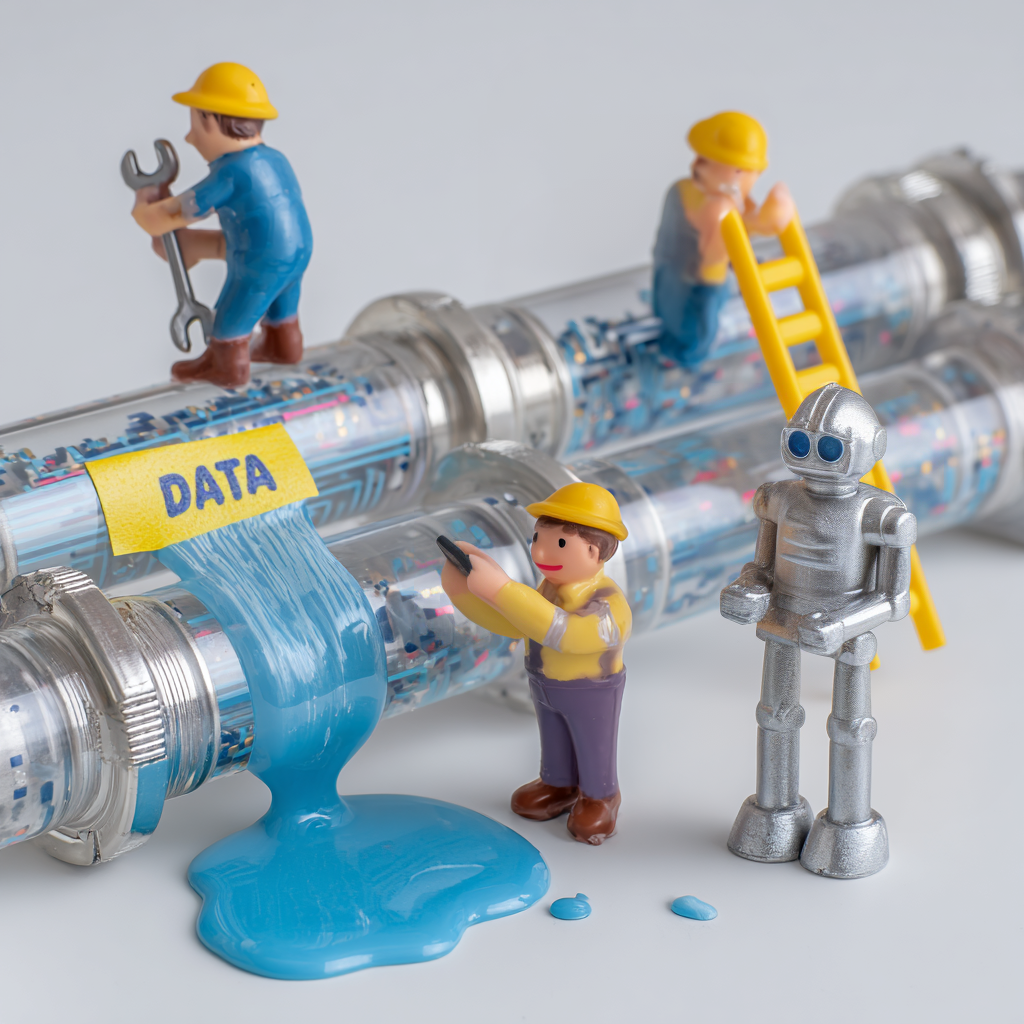
AI didn’t break most business systems — it exposed them.
AI removes that buffer. Models don’t know which column is “usually” correct. They don’t infer intent from institutional memory. They operate strictly on what the system actually provides. Many AI initiatives stall early not because the models are weak, but because the data foundations were never designed to support this level of rigor.
The Expensive Mistake: Chasing AI Before Fixing Foundations
In the rush to adopt AI, many organizations invert the order of operations. They select tools, experiment with models, and hire specialists while underlying data pipelines remain brittle.
The failure mode is predictable. Outputs are inconsistent. Trust erodes. The conclusion becomes that AI is unreliable or overhyped.
In reality, the system was never ready.
Schema drift, unclear definitions, and fragmented pipelines undermine not just AI, but any attempt at automation or advanced analytics. These issues compound as complexity grows. The more sophisticated the tooling, the more visible the cracks become.
What feels like an AI problem is often a data engineering problem that’s been deferred for years.
The Real Opportunity: Value Before AI
Here’s the counterintuitive part: fixing data systems delivers value even if AI never enters the picture.
Clear schemas improve reporting accuracy. Reliable pipelines reduce operational risk. Explicit ownership and documentation make systems easier to evolve. Teams stop arguing about whose numbers are “right” and start acting on shared reality. AI doesn’t create the need for this work, but it does remove the excuse to avoid it.
Organizations that treat data cleanup as a prerequisite for intelligence miss the point. Strong data foundations are not preparation. They are leverage.
Conclusion: Discipline Beats Hype
There is nothing magical about AI operating on fragile systems. Precision tools amplify precision while simultaneously exposing the places where precision is lacking.
This is a recurring theme in this series: as assumptions break down, fundamentals matter more. In this case, strong data systems outperform ambitious AI layered on top of chaos.
Strong data foundations beat magical AI promises every time.
In the next article, we’ll look at another assumption that’s quietly failing — that rapid growth is the only environment in which good software strategy can exist.