One of my favorite business analogies is called the Doorman Fallacy.
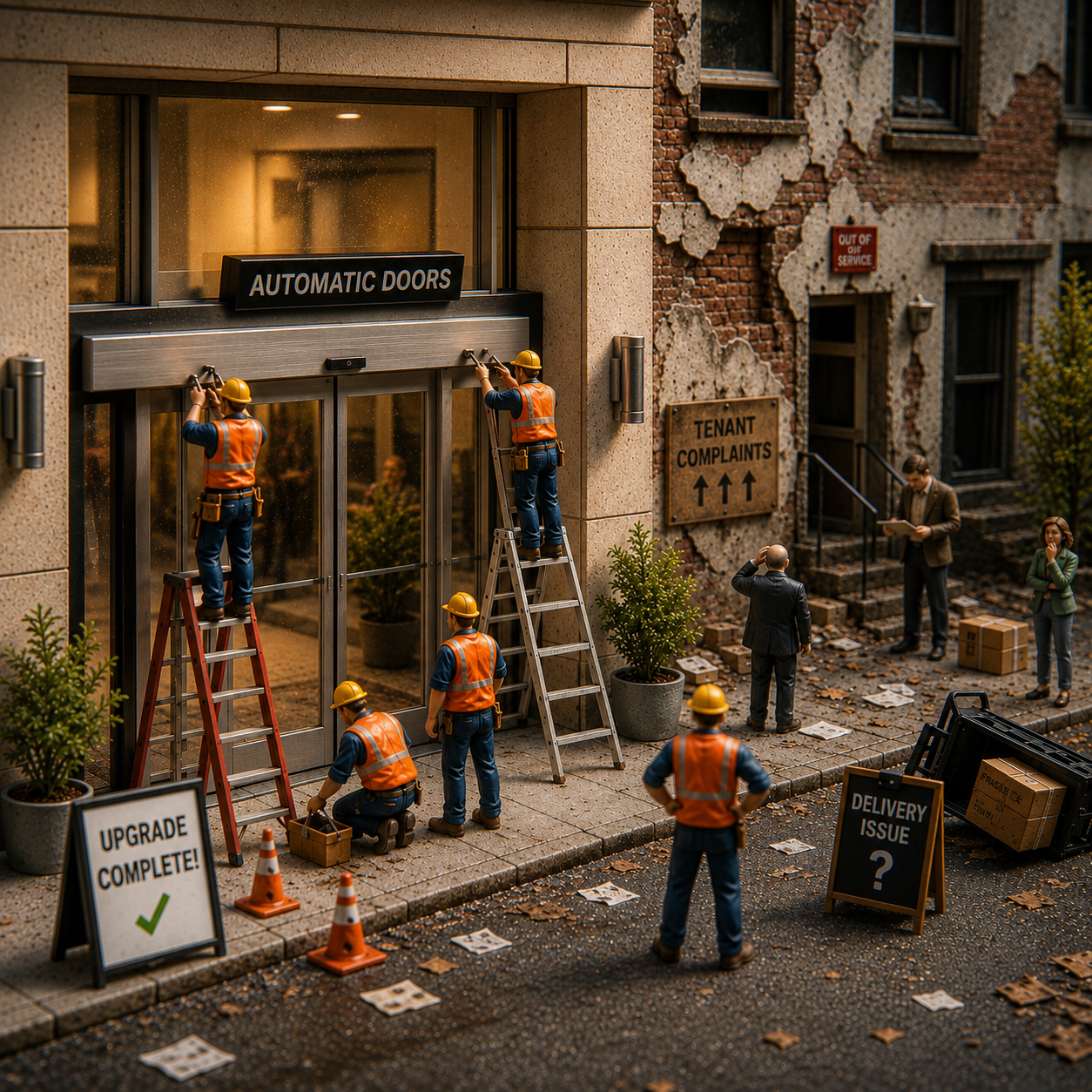
Imagine the owner of an office building looking for ways to cut costs. They notice the doorman spends most of the day opening doors, greeting visitors, and occasionally accepting deliveries.
"Automatic doors are cheap," they think. "Let's install those and eliminate the salary."
At first, it looks like a brilliant decision. The doors still open. Visitors still enter the building. On the surface, nothing has changed.
But over time, the building begins to decline. Prospective tenants choose other offices. Complaints become more frequent. Deliveries go missing. Unauthorized visitors wander through the lobby. Vendors struggle to find the right offices, and the building simply feels less professional.
The owner made a common mistake: they assumed opening doors was the doorman's job because it was the most visible part of the work. In reality, opening doors was only a small fraction of the value the doorman provided.
AI Can Write Code. Engineers Build Software.
Code Isn't the Product
I see this exact misunderstanding playing out in software development today.
People watch experienced engineers write code and conclude that writing code is software engineering. So when AI becomes capable of generating thousands of lines of code in minutes, it's tempting to assume engineers have become optional.
AI is changing how software gets written. Experienced engineers are still the ones who make software succeed.
After more than twenty years as an engineer, I can tell you that's like believing the doorman's entire job was opening doors.
Writing code is just one task within software engineering. The real work happens in the countless decisions that shape a successful project: designing a maintainable architecture, anticipating future requirements, balancing performance against flexibility, protecting security, planning deployments, and avoiding technical debt before it accumulates.
Judgment Can't Be Prompted
That's why AI is such a powerful tool—and why it isn't a replacement for software engineering.
I use AI regularly because it dramatically accelerates implementation. But AI doesn't own the project. It doesn't understand your business goals, challenge conflicting requirements, or recognize when a shortcut today will become a costly problem next year. Those are engineering responsibilities.
The companies getting the most value from AI understand this distinction. They've automated one important task, not an entire profession. Confusing code generation with software engineering is the software industry's version of replacing the doorman with automatic doors.
Get Your AI Project Back on Track
If your AI-generated project has started to feel difficult to maintain, impossible to extend, or simply isn't heading in the direction you envisioned, Performance Automata can help.
We specialize in taking AI-generated code and transforming it into production-ready software that's scalable, maintainable, and built for the long term. Whether your project needs architectural guidance, refactoring, performance optimization, or an experienced engineer to steer it back on course, we'll help you unlock the full potential of the code your AI has already written.
Ready to turn AI-generated code into software you can confidently build on? Get in touch to discuss your project and see how we can help.
AI is changing how software gets written. Experienced engineers are still the ones who make software succeed.